The Phantasmagoria of Seeming
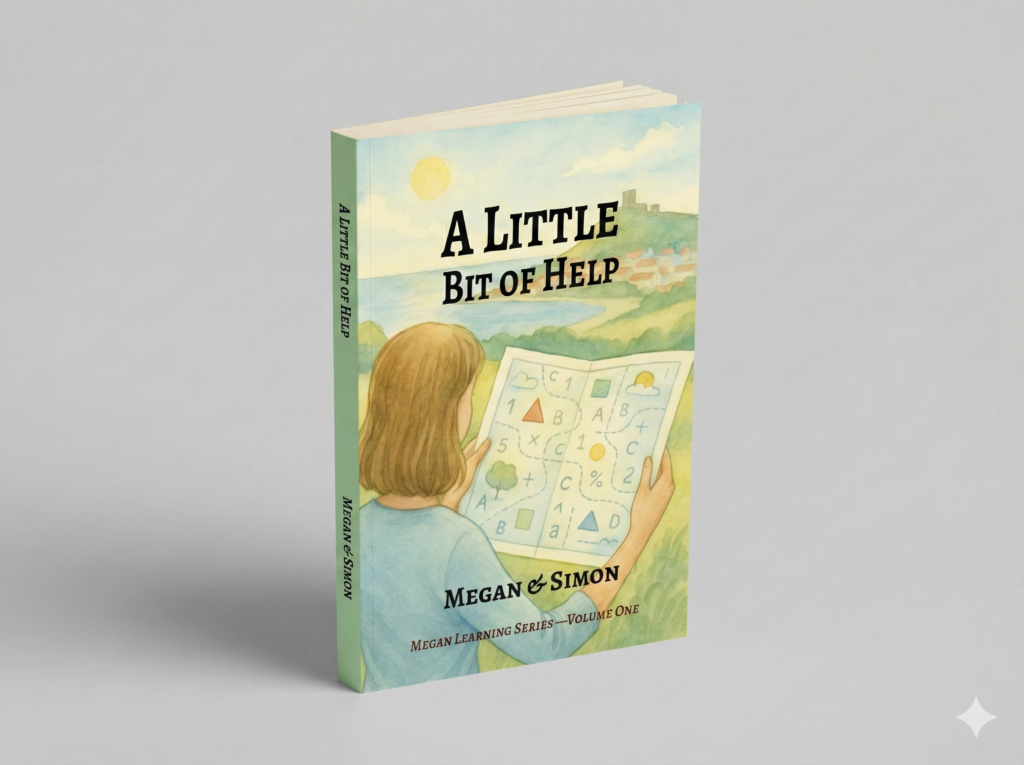
A Little Bit of Help
An exploration of how recognition becomes understanding.
A long-form resource for educators, psychologists, and thoughtful carers interested in language, perception, and the slow emergence of practical understanding.
The assumption we rarely question
Most educational systems quietly assume that perception is already in place. They assume the learner already sees a world made of stable objects, recognisable categories, and dependable relationships — and that the task of teaching is simply to explain what these things mean.
My own findings suggest otherwise. Before reading, before number, before explanation, there is something more basic: the gradual stabilisation of the world into named things.
What appears from the outside as a difficulty with literacy, attention, or behaviour may sometimes be a problem of earlier organisation. The learner is not failing to think about a stable world. The world itself has not yet become stable enough to support thought.
A working hypothesis
This page is not offered as doctrine or comparison. It is a practical hypothesis derived from direct experience:
Recognition comes before understanding.
Naming stabilises recognition.
Once enough stable recognitions exist, abstraction begins to emerge.
Put simply: if a learner can reliably recognise even a single common noun, something changes. A stable object appears. With that, a rudimentary subject-object relationship begins to form. From there, vocabulary can grow. With vocabulary, thought begins to extend.
Why nouns come first
The earliest useful words are usually not theoretical. They are familiar, repeated, emotionally embedded, and constantly available: Mum, Dad, one’s own name, the dog, the cup, the bed, the car.
A noun is helpful because it points to something that can be returned to. It has edges. It can be seen again. It can be touched, pointed at, or held in memory against the same recurring object.
Begin with nouns the learner already half-knows from daily life. Do not begin with an ideal curriculum. Begin with what is already present, familiar, and repeated.
In the book itself, this principle sits quietly underneath everything: home objects, family roles, clothing, food, simple places, weather, transport, and everyday routines recur again and again in accessible, concrete language. The contents move through words, calendar, watch, colours, shapes, maps, the five senses, fractions, types of cars, laundry, weather, furniture, household items, and common categories of daily life. This makes the language habitual rather than decorative. [oai_citation:3‡A little Bit of Help Revision compressed.pdf](sediment://file_00000000a4fc7206a13ea619a8e2e2b4)
The phenomenological ladder
I find it helpful to think of learning as a ladder. Not a ladder of intelligence, but a ladder of stabilisation.
Diagram 1 — Recognition to abstraction
A single familiar noun is recognised.
Different instances begin to belong together.
Differences within the class become visible.
Colour, shape, size, number attach meaningfully.
Opposites, order, time, quantity, and planning emerge.
This is why class and type matter so much. Once the learner has a stable noun, the next task is not endless new nouns, but the gentle emergence of structure.
Class
dog, dog, dog → “dog” becomes a dependable category.
Type
small dog, big dog, different breeds → differences inside the category become visible.
Cars are especially useful here. They allow progression from a single object to a class, then to type, then to make and model. The revised book includes “Different Types of Cars” as an explicit step in this kind of learning. [oai_citation:4‡A little Bit of Help Revision compressed.pdf](sediment://file_00000000a4fc7206a13ea619a8e2e2b4)
Open and closed
One of the clearest examples of learned perception is the humble sign: Open and Closed.
For the fluent reader, these words seem self-evident. But to the illiterate learner, they may effectively not be there. The sign is visible in one sense, yet absent in another. The letters are seen, but the object has not become meaningful.
This is why repeated exposure matters so much. Familiar routes, repeated shops, common road signs, recurring labels: these provide the conditions for a word to shift from guesswork into recognition.
Colour and shape: the building blocks of visual language
Colour and shape are often treated as basic teaching categories, but they are not basic in the same way a noun is basic. They are attributes. They need somewhere to attach.
A colour on its own is surprisingly abstract. A shape on its own is more stable, but still benefits from a familiar object. A red cup is easier than “red”. A circle on a wheel is easier than “circle” as a free-floating lesson.
Diagram 2 — Object before attribute
cup
red
round
a recognised red cup
The book addresses this gently through chapters on colours and shapes, and through later vocabulary pages grouping colours, shapes, household objects, food, transport, and common things into repeatable visual-linguistic sets. [oai_citation:5‡A little Bit of Help Revision compressed.pdf](sediment://file_00000000a4fc7206a13ea619a8e2e2b4)
Number, order, and orientation
Number is one of the first true abstractions, and it is rarely learned quickly. It depends on order, comparison, and repetition. A learner may recite numbers long before the felt reality of quantity has fully stabilised.
Here too, the practical world is more helpful than formal teaching. Time, dates, buses, watches, calendars, journeys, prices, and small household quantities all provide scaffolding.
With number, certainty often arrives late. Familiarity matters before mastery.
In A Little Bit of Help, this shows up in the chapters on the calendar, watch, fractions, the third digit, sixty, and the appendix groupings on time, months, maths, and common ordering words. [oai_citation:6‡A little Bit of Help Revision compressed.pdf](sediment://file_00000000a4fc7206a13ea619a8e2e2b4)
Opposites and early abstraction
Opposites are extraordinarily useful because they allow abstract concepts to arrive in pairs. Up and down. Left and right. Hot and cold. Big and small. Open and closed.
One term helps define the other. The learner does not have to hold a free-floating concept alone; each side stabilises through contrast.
This is also where patience becomes brutal and indispensable. Some opposites — especially left and right — may take years to become reliable. That is not a sign of futility. It is simply a sign that these are high-order orientation concepts, not trivial labels.
Dialogue, error, and natural language
The stories in the book are deliberately close to lived speech. They do not pretend to be perfect literary exercises. This matters.
A learner’s language may be partial, compressed, idiosyncratic, or grammatically incomplete, but it is often pure in intention. Rather than overwrite this, the better approach is to let it appear in dialogue, then place alongside it the teacher’s clearer prompt, expansion, or correction.
- It keeps the learning personal.
- It preserves the learner’s own language structure.
- It offers a model of clearer syntax without humiliation.
- When revisited later, it creates a visible record of progress.
This is one reason the short-story form works so well. The book is not only teaching words. It is quietly recording the gradual emergence of more stable language and comprehension through repeated, emotionally relevant scenes. [oai_citation:7‡A little Bit of Help Revision compressed.pdf](sediment://file_00000000a4fc7206a13ea619a8e2e2b4)
Senses, mind, and misalignment
If there is difficulty in the natural process of objectification, I find it more helpful to think in terms of misalignment than damage. What seems broken may instead be poorly coordinated.
Learning depends on some working coherence between the senses and the mind: seeing, hearing, touching, remembering, orientating, and naming. If this coordination is weak or variable, the world does not become reliable quickly.
The learner may seem inattentive when, in reality, the object has not yet separated cleanly from its surroundings. This is why repetition is not remedial in a narrow sense. It is constructive. It helps the world come into view.
The chapter on the five senses is useful here not because it offers theory, but because it returns learning to its raw materials: seeing, hearing, smelling, tasting, and touching. [oai_citation:8‡A little Bit of Help Revision compressed.pdf](sediment://file_00000000a4fc7206a13ea619a8e2e2b4)
About the book
A Little Bit of Help — Revised Edition
- Subtitle
- Learning words, numbers, and independence together
- Author
- Simon Robinson
- Series
- Megan Learning Series, Vol. 1
- ISBN
- 978-1-0684310-5-0
- Edition
- Revised Edition, 2025
- Format
- Paperback
- Publisher
- Simon Robinson, Scarborough, North Yorkshire, UK
- Distribution
- Printed and distributed by IngramSpark in the United Kingdom, United States, and Australia
- Companion resource
- Learning cards and companion materials available via drsimonrobinson.com/learning-cards
The revised edition frames the work as part of a broader educational series integrating literacy, numeracy, and social understanding for young adult learners, while also making the learning cards available as companion resources. [oai_citation:9‡A little Bit of Help Revision compressed.pdf](sediment://file_00000000a4fc7206a13ea619a8e2e2b4)
Purchase links
Buy A Little Bit of Help
These links point to currently indexed retailer pages for ISBN 978-1-0684310-5-0.
Closing thought
This is not, in the end, a book about deficiency. It is a book about emergence. It asks what becomes possible when familiar objects are named clearly enough, often enough, and patiently enough for the world to begin holding still.